Over the long bank holiday weekend I've only managed a couple of hours birding, that being a visit to the marshes on Sunday evening, where I found a nice Wood Sandpiper on the Colyford Common Scrape. It was 'mucho distant' as is usual here so I didn't even attempt a photo of it. Why so little birding? Well, I've spent the best part of all four days looking at butterflies and generally basking in the unbridled beauty that is late spring (which is a couple of weeks early this year). Firstly, on Friday I took advantage of the almost deserted roads ( was I missing something?) to make a quicker than usual trip to a site on the edge of Dartmoor. Here I was hoping to see Pearl-bordered Fritillaries. The date was more or less the same as when I was here last year and when I immediately saw some small orange fritillaries I assumed these were Pearl-bordered Fritillary. When I got a close look at the underside of one I realised it was in fact a Small Pearl-bordered Fritillary. I began to look more closely at others and soon realized that they were almost all small pearl-bordered. I only found one very worn pearl-bordered among them. It was only the 29th of April and they had already 'gone over' at this particular site. In 'all the books' it says that the Pearl Bordered Fritillary used to be called the April Fritillary but its name was changed when the calendar was reduced by eleven days in 1752 and the butterfly was then not seen until May. It's certainly still the April Fritillary at this site.
Saturday and Sunday I visited a site in Somerset, on Saturday to look for Duke of Burgundy Fritillary, which I'm happy to say I found, and on Sunday with Bun because he wanted to see Bird's Nest Orchid! (okay, that is a joke). After nobody ( I know of) seeing more than a single female at this site last year it was looking very grim for this lovely and rare little butterfly. The good news is that on both days I managed to count four males and one female and without thoroughly searching the whole site. There were masses of Grizzled Skippers here too along with Dingy Skippers, Holly Blues and Common Blues. An added bonus, and a big one at that, were half a dozen singing Nightingales one of which we had superb views of in the salubrious setting of a travellers site. "It's showing well!... There... Behind that burnt out mobile home" was the cry. Fortunately when watching a Nightingale in full song, the sight is so captivating that the surroundings become all but invisible, well I think so anyway. We also got to see several Bird's Nest Orchids (much to Bun's delight) these like everything this year being very early.
On Monday the destination was the Haldon Forest, to the south of Exeter where Pearl-bordered Fritillaries were still very much on the wing. Despite the generally cloudy weather there were scores of them. They make a glorious sight amongst the spring woodland flowers. The two Pearl Bordered Fritillaries' scientific names are after two Greek goddesses. The Small Pearl-bordered Fritillary is Boloria selene, Selene being the moon goddess and here I can't see a connection. The Pearl-bordered Fritillary however, is perfectly named Boloria euphrosyne. Euphrosyne is one of the 'Three Graces' and the Goddess of Joy. It is ( in my opinion ) very difficult not to feel joy in the presence of these exquisite creatures, even whilst standing under monstrous pylons and crackling power lines, which at one site we were.
I simply love this time of year, May is definitely my favourite month. I'm not at all good at expressing myself in the written word so I'll let George A. B. Dewar do it for me. I have a book written by him in 1904. It's called (rather quaintly it seems today) The Glamour of the Earth. It's an account of the wildlife in his local woodlands in north Hampshire at the turn of the century. A very interesting read...I didn't know the Goldcrest used to be known as the Golden Wren, for example... anyway he says...
"Two butterflies, Euphrosyne and Selene, pearl-bordered and small pearl-bordered fritillaries, I never could think of apart from the short, glorious period of crowded life and rapture, which crowns the throned summer. Once to have tasted this time in the hazel coppices, it is a kind of sin not to watch for and taste it here-after."
...and I agree
I took lots of photos and here are a few of them...
Typical Small Pearl-bordered Fritillaries
A very strongly marked individual
Two views of the brightly patterned under-wing. George A.B. Dewar says..
"How exquisite in its detail is the checkered pattern on the under side of the wing of the Small Pearl-bordered Fritillary!" Once again I have to agree.
Amazing to think that as a small child, no matter how deftly I thought I was creeping up on a butterfly I seldom caught them, even with the aid of a net on a four foot pole! Now I can often just put my hand nearby and they just hop on! Actually this only works in cloudy conditions as the butterflies are probably attracted to the warmth of your skin. Some are attracted by minerals in your sweat too
Pearl-bordered Fritillary
The undersides of the wing are not as boldly patterned as on the small pearl -bordered, lacking the black markings but are equally as exquisite. In the bottom photo the butterfly is resting on the buds of
Wild Columbine. I've only ever seen
Columbine as a garden escape before.

Female egg-laying.
Here on a piece of dead Bracken but always very near to the caterpillar's food plant, violets. Sometimes eggs are laid directly on the violet's leaves....
...like this.
Very freshly emerged individual...George A.B. Dewar says..
"The Pearl-bordered Fritillaries are lovely for the first hours of their lives. Then they have a velvety bloom about them." Couldn't have put it better myself.
Male Duke of Burgundy
Males only have four (usable) legs
Females are generally more brightly coloured and have...
...the full complement of six legs.
Other Butterflies.
Grizzled Skipper
Obviously feeling a bit chilly.
Seeing it on my finger shows how tiny it is.
Dingy Skipper
Female Holly Blue laying egg on Dogwood flower buds.
Aesthetically challenged Bird's Nest Orchid
We visited Barrington Hill Meadows NNR in Somerset on the way home from seeing the dukes. There are thousands of Green-winged Orchids here, including a few almost white ones like this. I think they look especially beautiful in this colour with the green veins in the 'wings' showing so clearly.
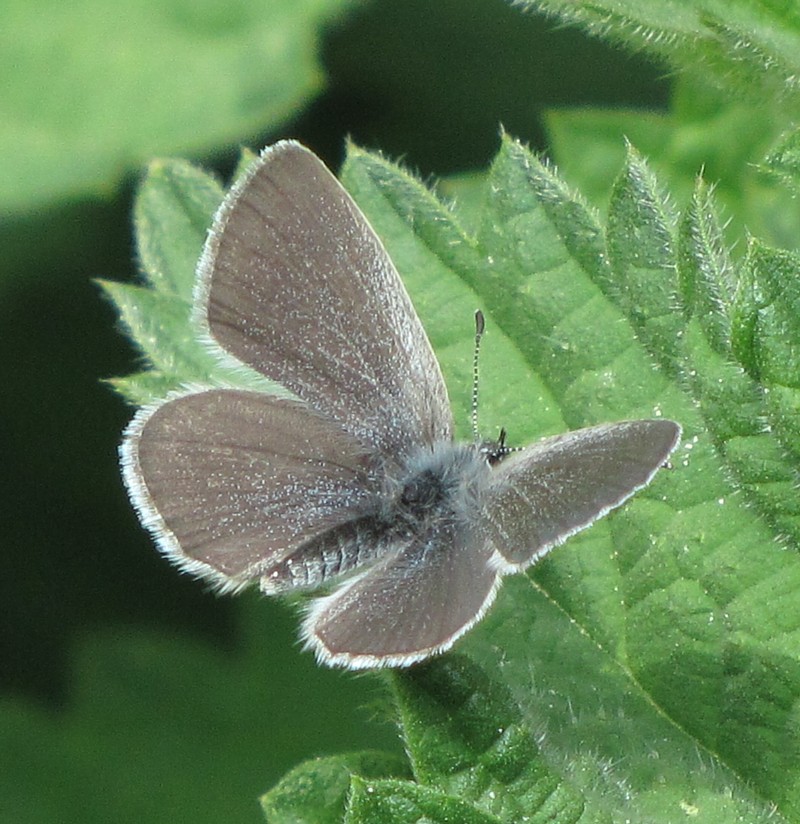
Yesterday I took a stroll along the beach to the east of Axmouth Harbour. It was sunny but also very windy, with the wind coming in off the sea. Butterflies were about but finding it hard to fly. I searched the vegetation and was thrilled to see this perched on a sheltered piece of Bird's Foot Trefoil
A brand spankin' new male Small Blue!
After seeing the lone male in the area last summer, this freshly emerged one is proof that they did indeed breed at the location, which is brilliant news.