Wednesday, 3 February 2016

Rare Flowers in The Avon Gorge and Cotswolds

Back in early July we spent a day botanising in the Avon Gorge and Gloucestershire. We didn't spend very long at the Avon Gorge as it was absolutely tipping it down, making photos difficult, well making everything difficult really! We managed to see the two flowers we were hoping to find though, Bristol Onion or Round-headed Leek at its only site in the UK and Western Spiked Speedwell.


Round-headed Leek - Allium sphaerocephalon
 

Western Spiked Speedwell - Veronica spicata subsp. hybrida

Then on to Badgeworth near Cheltenham to see the 'Badgeworth Buttercup' or Adder's-tongue Spearwort. We were way too late for this but were hoping that a few flowers may be hanging on. The  Badgeworth Nature Reserve is the smallest in the UK being just one small seasonal pond. We were that late in the season that there wasn't even any water left in it but fortunately one or two late flowers were still hanging on.


The Badgeworth Nature Reserve.
 If it wasn't for the boardwalk you'd never guess it was ever a pond.
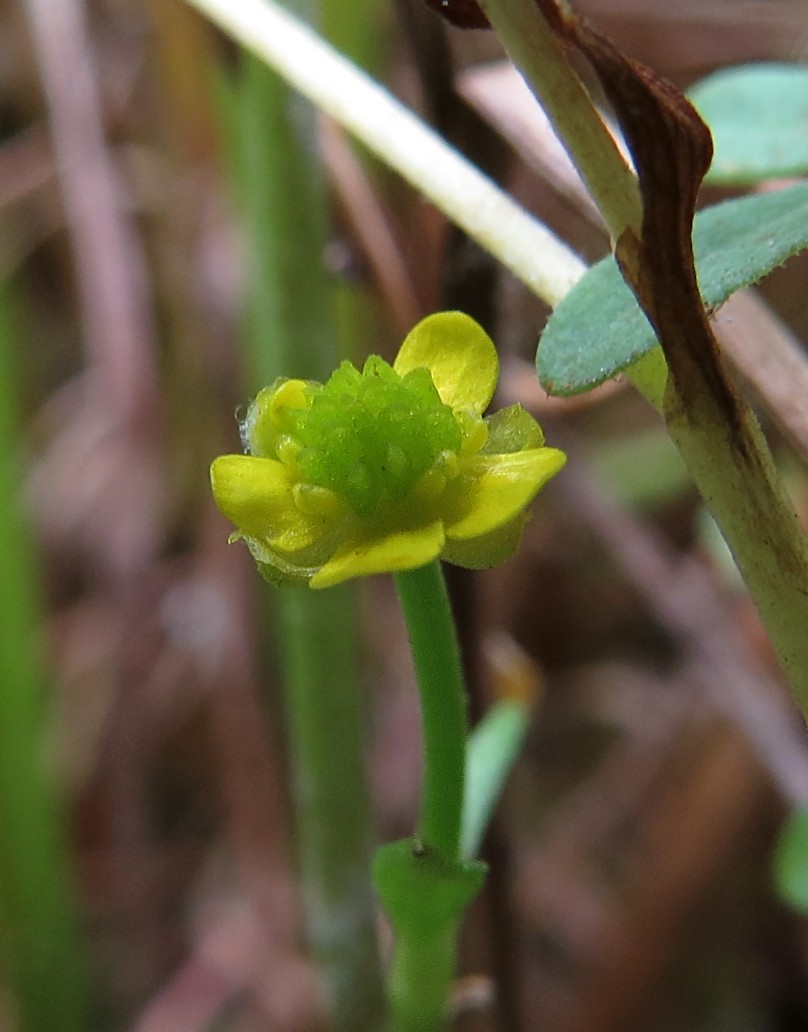


Adder's-tongue Spearwort -  Ranunculus ophioglossifolius

In The Cotswold Commons and Beechwoods we got reasonable views of the very rare orchid, Red Helleborine. There was  just a single flower spike and with there being just a single flower spike at its only other location in Buckinghamshire, that makes just two in the whole country, that's just how rare this flower is! I've been planning on going to look for it for years and I was thrilled to finally see it even if it was through a security fence. The flower spike had fallen over and so was quite difficult to spot but just enough in the open to get a photo with my 400mm lens.


Red Helleborine - Cephalanthera rubra


Near the wood where we saw the helleborine were a couple of naturalised species that I'd never seen before.


Caper Spurge - Euphorbia lathyris


Peach-leaved Bellflower - Campanula persicifolia 
Finally we popped in at a roadside reserve in the Cotswolds to see Limestone Woundwort, another very rare plant in the UK found at just to sites.


 Limestone Woundwort - Stachys alpina


Thursday, 28 January 2016

Naked Ladies at Velvet Bottom

The 'naked ladies' being the late flowering Meadow Saffron. Called naked ladies because they are leafless in flower and on long white stems. Leaves appear the following spring and die back in the summer. We saw them in mid October at Velvet Bottom reserve in the Mendips.


Meadow Saffron - Colchicum autumnale


We also bumped into this handsome chap tucking into the bracken.
Broom Moth Caterpillar - Ceramica pisi

Sunday, 24 January 2016

Weird and Wonderful Stinkhorns

A bit of a break from the wildflower posts today with the first of my fungi related posts ( I've a fair few of them too). I've seen three new types of stinkhorn this autumn each as weird and wonderful as the next. I'd seen Clathrus ruber, Red Cage Fungus last December (you can read about it here) and have been keen to see the other kinds which are all equally bizarre.

Firstly a trip to Oxshott in Surrey to see Aseroe rubra, the Starfish Fungus. Thanks to Steve Gale at North Downs and Beyond for some very useful gen on this one, which I doubt we'd have found it without. There were many 'eggs' but we were a bit early and only found a few which had 'hatched'. The smell from them is nowhere near as strong as from the Common Stinkhorn so they cannot be located by smell alone, and you'd think the bright red colour would make them very easy to spot. They are often tucked away under low vegetation though and are quite easy to miss until you 'get your eye in'.


Starfish Fungus - Aseroe rubra

The next was really easy to find in the New Forest where literally hundreds can be seen growing on a grassy plain and amongst gorse bushes. This was Clathrus archeri, Devil's Fingers Fungus.


Eggs just beginning to 'hatch' or erupt...


Almost fully erupted..


The finished article, which I would say was more like a starfish than the Starfish Fungus. 
But it can look very finger-like too. 


The mature bodies don't last very well in sunny and windy conditions, soon drying up like this one.
 
 
Devil's Fingers - Clathrus archeri

The third stinkhorn, supposed to be common but was one that I hadn't managed to spot until we saw a large group of them in a wood this autumn is Mutinus caninus, The Dog Stinkhorn. They were in a shady conifer plantation and unfortunately my photos were a bit of a disaster and I only get one decent one thus...


Dog Stinkhorn - Mutinus caninus

Finally the stinkiest stinkhorn of them all... 


Common Stinkhorn -Phallus impudicus 

Several years ago I wrote a blog post about the Common Stinkhorn called 'Shameless!'
Complete with the wonderful story of Henrietta Darwin (Charles Darwin's erotophobic daughter) read it HERE.